Home Blog Page 169

Healthy New Year’s Goals You Should Be Setting Right Now

0

The start of the year can feel like a time of endless possibilities — when you decide you’ll finally clean out your closet, find love, or shed those stubborn 10 pounds. The reality, of course, is that realistic New Year’s resolutions are about setting priorities, not trying to fix everything at once.

This year, consider prioritizing your heart health. It might not be as trendy or flashy as other New Year’s resolutions, but there are plenty of reasons to do so. Heart disease is the leading cause of death for women, men, and nearly every racial and ethnic group in the United States, according to the Centers for Disease Control and Prevention (CDC). And the factors that often contribute to heart disease — like high blood pressure, increased blood lipid (cholesterol and triglyceride) levels, and prediabetes or type 2 diabetes — can begin long before you’re diagnosed with any heart condition or experience a cardiovascular event like a heart attack or stroke.

When it comes to prioritizing heart health, “Some people are really shocked into action,” says Helga Van Herle, MD, a cardiologist and associate professor of clinical medicine at the Keck School of Medicine at the University of Southern California in Los Angeles. That could happen, she says, following a diagnosis of heart disease or being prescribed a cholesterol-lowering medication.

But you may be able to avoid getting to that point by taking action now — and nudging your lifestyle in a heart-healthy direction. “Some of the basic stuff that rings true is actually the most important” when it comes to heart health, says Evan Shalen, MD, a cardiologist and assistant professor of medicine at Oregon Health and Science University in Portland.

Source: People

Things You Need to Know about Excessive Sweating

0

Do you find yourself wondering why you sweat so much? Relax. Everyone sweats. Sweating is a normal response to heat or anxiety,” says Hunter Q. Kirkland, MD, a cardiothoracic surgeon at Cardiothoracic and Vascular Surgeons in Austin, Texas. But while sweating is the body’s way of cooling off, some people sweat excessively — sweaty armpits, sweaty necks, and sweaty, smelly feet — and for no apparent reason, making them feel as though they’re living in a sauna 24/7.

This may be due to a diagnosable medical condition called hyperhidrosis, which affects almost 4.8 percent of the population, or about 15.3 million Americans, according to research. Normally, we sweat to cool our body and control our body’s temperature. But too much sweat can cause stained shirts and body odors, affecting social relationships and even self-esteem.

According to the Mayo Clinic, hyperhidrosis (high-purr-high-DROE-sis) is abnormally excessive sweating that’s not necessarily related to heat or exercise. People with hyperhidrosis sweat so much that it soaks through their T-shirts or drips off their hands. Besides interrupting a normal life, hyperhidrosis can result in major embarrassment and social anxiety.

The most common type of hyperhidrosis is primary focal or essential hyperhidrosis, in which the nerves that trigger your sweat glands become overactive. Even if you aren’t running or hot, your feet, hands, or face will sweat.

A more serious type of abnormal sweating is called secondary hyperhidrosis, which signals a dysfunction of the central or peripheral nervous system. This type of excessive sweating is generally the result of a medical condition, including:

Diabetes
Heart attack
Infections
Low blood sugar
Menopausal hot flashes
Nervous system disorders
Some types of cancer
Thyroid problems
Though excessive sweat isn’t serious or life-threatening, it can be embarrassing and make you uncomfortable and anxious. There are medical treatments for hyperhidrosis, but you’ll need to make an appointment with your primary care physician. One study found that primary hyperhidrosis increased the risk of bacterial and fungal infections on the skin. So, if your excessive sweating seems too much, see a doctor to get back in control and avoid possible infections.

Here are seven things to know about excessive sweating — how to manage it, where it’s most common on the body, and how to tell whether you are exhibiting signs of hyperhidrosis.

Source: everydayhealth

Best Stretches for healthy running routine

0

Flexibility training is an essential component of a healthy running routine. Regularly carving out time for flexibility exercises can help keep muscles flexible and maintain joint range of motion. If your joints can’t move through their entire range of motion, your muscles can’t either, causing them to shorten and become tight, according to Harvard Medical School.

In addition to being potentially uncomfortable, muscle tightness can limit your running performance and increase your injury risk.

I emphasize flexibility training for runners because tight muscles can alter proper running mechanics, putting strain on joints and connective tissue,” says Ashley Castleberry, a National Academy of Sports Medicine (NASM)–certified personal trainer in Tampa, Florida, who works with runners. “This greatly increases injury risk in an already-high-impact activity like runningTwo areas runners often complain about are the quadriceps (the large muscles in the front of your thighs) and hip flexors (a group of muscles along the front of your upper thighs). As Tori LaBrie, an NASM-certified corrective exercise specialist and certified athletic trainer with Texas Orthopedics in Austin, explains, while running involves all of the major muscle groups, many runners tend to overcompensate with their quads and hip flexors. The added stress can make these muscles feel especially tight, which can affect your performance in the long run.

Tight hip flexors, for example, limit how far you can extend (straighten) your hips while running, which prevents your glutes (buttocks) from kicking in to provide speed, says Mike Thomson, CSCS, a USA Track and Field–certified running coach with Life Time in Overland Park, Kansas.

If your quads are tight, your legs can’t extend back far enough. This may cause you to overstride, or land with your front foot too far forward, Castelberry notes. According to Boston Children’s Hospital, overstriding means landing with stiffer, straighter legs that can’t absorb your body’s landing forces very well, which may lead to shin, knee, or hip injuries.

Thomson points to the calves as another running-centric muscle group to focus on. The International Sports Sciences Association (ISSA) notes that tightness in the calves can contribute to plantar fasciitis, a common running injury that’s characterized by heel pain. Achilles tendinitis, a condition that causes pain and inflammation in the tendon that connects the calf muscles to the heel bone, can also occur if the calf muscles are tight, per the American Academy of Orthopaedic Surgeons (AAOS).

In addition, calf tightness can lead to pain upstream, particularly in the side of the knee, Thomson says.

Knee pain may also result from tightness in the iliotibial (IT) band, a long cord of connective tissue that extends from the hip to just below the outside of the knee. Per the Hospital for Special Surgery, knee pain that’s caused by IT band tightness is known as IT band syndrome, a common overuse injury in runners,

Targeting the muscles you use when running with flexibility practices like stretching can increase your range of motion, preventing and improving muscle tightness. This may boost running performance and reduce injury risk, though the authors of a recent review say more research is needed.

Source: everydayhealth

Everything you need to know about Increasing your Walking Speed May Cut Diabetes Risk

0

Picking up your pace when you walk could offer extra protection against developing type 2 diabetes. In a new study published in the British Journal of Sports Medicine, researchers in Iran determined that maintaining a habitual walking speed of 2.5 miles per hour (mph) or faster significantly lowered the chances of having type 2 diabetes in the future. Every 0.6 mph increase was associated with a 9 percent risk reduction.

“Our results provide support for the incorporation of walking speed into physical activity guidelines,” says lead study author Ahmed Jayedi, PhD, a researcher in nutrition at Semnan University of Medical Sciences in Iran. “While current strategies to increase total walking time are beneficial, it may also be reasonable to encourage people to walk at faster speeds to further increase the health benefits of walking.”

When it comes to frequency, the Centers for Disease Control and Prevention (CDC) already recommends getting at least 150 minutes a week of moderate exercise to maintain overall health. This can be in the form of brisk walking, which is at a pace of 3 mph or faster, according to the CDC.

The health agency also estimates that the average walking pace for an adult is about 3 mph — so if you’re keeping up with the average, you could be on track for greater potential disease protection, according to this investigation.

To arrive at these results, Dr. Jayedi and his team analyzed data from 10 studies that explored the association between walking speed and the risk of type 2 diabetes in adults. The prior studies, which were published between 1999 and 2022, monitored just over half a million adults from the United States, Japan, and the United Kingdom, for periods ranging from 3 to 11 years.

Pooled data analysis revealed that compared with strolling at under 2 mph, an average or normal walking speed of 2 to 3 mph was associated with a 15 percent lower risk of type 2 diabetes, regardless of the time spent walking.

Fairly brisk walking at a speed of 3 to 4 mph was associated with a higher disease-risk reduction of 24 percent compared with strolling. That risk reduction jumped to 39 percent if habitual walking pace was greater than 4 mph.

Study authors estimated that this highest level of risk reduction was the equivalent of 2.24 fewer cases of type 2 diabetes per every 100 people.

The analysis emphasized that the key to getting the benefit was reaching the threshold of a habitual walking speed of 2.5 mph — or 87 steps per minute for men and 100 steps per minute for women.

A fitness tracking device like a pedometer may help keep accurate track of speed. Without such a device, the CDC says you can tell if you’re doing moderate-intensity physical activity if “you can talk, but not sing during the activity.” At a higher “vigorous” level, you won’t be able to say more than a few words without pausing for a breath, according to the health agency.

Source: News365

All you need to know about the Strength Exercises for Walkers

0

You might think of walking as just a lower-body exercise. That’s not necessarily the case, says Carrie Boyle, a walking coach with the Bridgehampton, New York–based virtual walking program 99 Walks and a National Academy of Sports Medicine–certified personal trainer. “We’re activating the entire body when walking.”

Your core, upper back, and shoulders support good posture, while your arms swing or pump at your sides. With each step, your glutes (buttocks) engage, and your calves, ankles, and feet keep you stable, Boyle explains. Those muscles work even harder if you walk uphill or add weight (by wearing a backpack or weighted vest), she adds.

Uphill walking also targets the quadriceps (the muscles in the front of your thighs), glutes, and calves more than walking on level ground does, research finds.

Walking is great exercise, and you can maximize benefits by pairing the activity with strength-based training, says James N. Robinson, MD, a primary sports medicine physician at the Hospital for Special Surgery in New York City. “In general, for good health you need full-body strength training, which will help you function better in day-to-day life,” he says.

In fact, research shows that combining a 10-week walking program with resistance training at home can improve muscle quality and size in older adults and enhance their ability to do everyday activities.

In addition, pairing walking with strength training may be a practical approach to maintaining a healthy weight. A study that included nearly 12,000 healthy adults of all ages found that those who met weekly recommendations for aerobic exercise (150 minutes of moderate-intensity activity, such as walking) and resistance exercise (two full-body sessions) had the lowest risk of developing obesity, compared with those who didn’t meet either exercise marker.

When building a strength routine to complement walking, focus on targeting the muscles most used in your workouts, such as your glutes, quadriceps, hamstrings (the muscles in the back of your thighs), ankles, and feet.

Source: everydayhealth

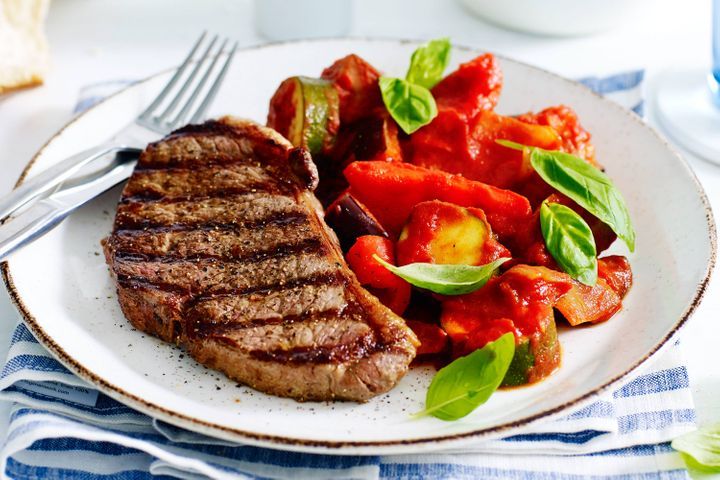
Chargrilled rump steak with ratatouille recipe

0

Chargrilled rump steak with ratatouille recipe. Create a vegie-packed family dinner with this chargrilled rump steak served with homemade ratatouille.

20m prep
35m cook
4 servings

13 Ingredients

* 1/4 cup (60ml) olive oil

* 1 large brown onion, cut into large pieces

* 2 bay leaves

* 1 eggplant, cut into large pieces

* 4 garlic cloves, sliced

* 3 thyme sprigs

* 2 zucchini, thickly sliced

* 1 red capsicum, cut into large pieces

* 690g btl Italian passata

* 4 x 220g Beef Rump Medallions

* Olive oil spray

* Basil leaves, to serve

* White sourdough bread, to serve

3 Method / Steps

Step 1

Heat the oil in a large saucepan over medium heat. Add the onion and bay leaves. Cook, stirring, for 5 mins or until onion softens. Add the eggplant, garlic and thyme. Cook for 5 mins or until eggplant starts to brown. Add the zucchini and capsicum and cook for 2 mins. Stir to combine. Add the passata and bring to a simmer. Cook, stirring occasionally, for 20 mins or until vegetables soften. Season.

Step 2

Meanwhile, heat a barbecue grill or chargrill on medium-high. Spray steaks with oil. Season. Cook for 3 mins each side for medium or until cooked to your liking. Transfer to a plate and cover with foil. Set aside for 5 mins to rest.

Step 3

Divide the steaks and ratatouille among serving plates. Sprinkle with basil leaves. Serve with crusty bread.

source – tastecom

Beef soboro recipe

0

Beef soboro recipe. Tangy, sweet and delicious served over rice, soboro is a favourite in Japan and will be a hit in your household, too.

10m prep
20m cook
4 servings

10 Ingredients

* 2 cups jasmine rice

* 1/4 cup cooking sake

* 2 tbsp brown sugar

* 1/4 cup mirin

* 1/4 cup salt-reduced soy sauce

* 2 tbsp vegetable oil

* 650g lean beef mince

* 4 green onions, thinly sliced

* 2 bunches broccolini, trimmed

* 410g can baby corn spears, drained, halved lengthways

3 Method / Steps

Step 1

Cook rice following packet directions. Combine sake, sugar, mirin and soy sauce in a small jug.

Step 2

Heat oil in a wok or large frying pan over high heat. Add mince. Stir-fry for 5 to 7 minutes or until browned. Add sauce mixture and 1/2 the onion. Bring to the boil. Simmer for 2 minutes or until thickened slightly.

Step 3

Meanwhile, cook broccolini and corn in a saucepan of boiling water for 2 minutes or until just tender. Drain. Divide rice among serving plates. Top with mince mixture and remaining onion. Serve with broccolini and corn.

source – tastecom

Chicken & vegetable pasta bake recipe

0

Chicken & vegetable pasta bake recipe. For a quick midweek meal try this tasty chicken and vegetable pasta bake.

10m prep
20m cook
4 servings

7 Ingredients

* 350g dried spiral pasta

* 1/2 cauliflower (400g), cut into small florets

* 1 large zucchini, halved, sliced

* 1/2 Coles Hot Roast Chicken, meat shredded

* 530g jar bechamel sauce

* 1/2 cup grated cheddar

* 1/2 cup panko breadcrumbs (see notes)

2 Method / Steps

Step 1

Preheat the oven to 200C or 180C fan-forced. Cook the pasta in a large saucepan of salted boiling water following packet directions, adding the cauliflower and zucchini in the last 2 mins of cooking, or until the vegetables are just tender and the pasta is al dente. Drain well and return to the pan.

Step 2

Stir chicken and bechamel sauce into the pasta mixture. Transfer to an 8-cup baking dish. Top with cheddar and breadcrumbs. Bake for 10 mins or until crisp and golden.

source – tastecom

Chicken and bacon burger recipe

0

Chicken and bacon burger recipe.

8 Ingredients

* 2 chicken breast fillets

* 1 loaf Turkish bread

* 1 tbsp olive oil

* 4 bacon rashers, halved crossways

* 150g mixed salad leaves

* 1 just-ripe avocado, halved, stone removed, peeled, thinly sliced

* 1 ripe tomato, thinly sliced

* 1/3 cup (80ml) Paul Newman’s Own South West Ranch Dressing

4 Method / Steps

Step 1

Use a sharp knife to slice each chicken breast in half widthways. Place between 2 sheets of plastic wrap and use a rolling pin or meat mallet to gently pound to 5mm-thick.

Step 2

Cut the Turkish bread crossways into quartered. Split each bread in half.

Step 3

Preheat a barbecue or chargrill on high. Lightly brush the chicken and bread with oil. Cook the bread on chargrill for 1 minute or until toasted. Add the chicken to the chargrill and cook for 5-6 minutes or until golden brown and cooked through. Transfer to a tray. Add the bacon and cook, turning, for 2 minutes or until crisp.

Step 4

Place Turkish bread bases on serving plates. Spread with a little of the Paul Newman’s Own South West Ranch Dressing. Top the bacon, chicken, avocado, tomato and salad leaves. Drizzle with remaining dressing and top with remaining bread slices to serve.

source – tastecom

Choc-mint mousse cake recipe

0

Choc-mint mousse cake recipe. or all those mint lovers, this is the best after dinner mint thanks to layers of creamy cheesecake with a hint of peppermint and a dark chocolate minty topping. We have saved some time in the kitchen by using a store-bought mud cake to make the base. This makes life a bit easier – which is always welcome in the kitchen during Christmas time. Just remember to chill the mousse cake for 5 and a half hours!

45m prep
15m cook
12 servings

13 Ingredients

* 600g pkt bought chocolate mud cake (see notes)

* 250ml (1 cup) milk

* 4 egg yolks

* 55g (1/4 cup) caster sugar

* 300g white chocolate, finely chopped

* 60ml (1/4 cup) boiling water

* 3 tsp gelatine powder

* 600ml ctn thickened cream

* 2 tsp peppermint extract

* Green food colouring, to tint

Chocolate glaze

* 2 x 100g block Lindt mint intense dark chocolate, finely chopped

* 185ml (3/4 cup) thickened cream

* 2 tbsp liquid glucose

9 Method / Steps

Step 1

Release the base of a 22cm (base size) springform pan. Invert base, then line with baking paper. Secure base back in the pan, allowing paper to overhang.

Step 2

Use a serrated knife to cut the top of the cake to remove the icing. Cut the cake in half crossways to make two semi circles. Cut each semicircle in half horizontally. You should now have 4 semi-circle pieces. Place 3 semicircles in the base of the lined pan to cover the base as much as possible, trimming to fit. Cut the remaining cake into smaller pieces to fill any gaps. Use clean hands to press the cake to seal any seams and evenly flatten.

Step 3

Place the milk in a saucepan over medium-high heat. Bring to a simmer. Use electric beaters to beat egg yolks and sugar in a bowl until pale and creamy. With the motor on low, gradually add the hot milk to the egg mixture in a thin, steady stream. Pour mixture into the pan and cook, stirring, over low heat, for 5 minutes or until custard thickens and coats the back of a spoon.

Step 4

Place white chocolate in a heatproof bowl. Pour the custard over the chocolate. Set aside for 5 minutes to melt chocolate. Stir until smooth and combined.

Step 5

Place the boiling water in a small bowl. Sprinkle with the gelatine. Stir until dissolved. Stir into the chocolate mixture. Pour half the mixture into a separate bowl. Cover the custard surface of 1 bowl with plastic wrap (this will stop a skin forming creating a lumpy custard). Add the peppermint extract to tint to the remaining custard mixture and tint mint green with food colouring.

Step 6

Use electric beaters to beat half the cream in a bowl until firm peaks form. Add to the green mixture and gently fold to combine. Pour the green mixture over the cake base and smooth the surface. Place in the fridge for 30 minutes or until just set.

Step 7

Use clean electric beaters to beat the remaining cream in a bowl until firm peaks form. Add to the remaining chocolate mixture and gently fold to combine. Pour over the green layer and smooth the surface. Place in the fridge for 4 hours or until set.

Step 8

To make the glaze, combine the mint chocolate, cream and glucose in a small saucepan. Stir over low heat until melted and smooth. Cool slightly. Pour over the mousse layer. Place in the fridge for 1 hour to set.

Step 9

Run a flat-bladed knife around the edge of the pan to loosen. Release cake from pan and transfer to a serving plate. Cut into wedges to serve.

source – tastecom